
Also called Powers. The exponent of a number says how many times to use the number in a multiplication.
For example, in 32, here the exponent is 2, and this 2 says that use 3 twice in a multiplication as shown below:
32=3×3=9
Similarly,
24=2×2×2×2=16
53=5×5×5=125
Negative Exponents
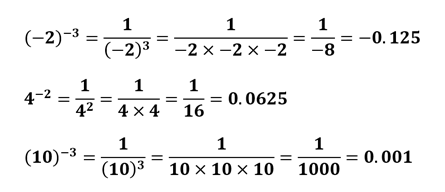
Means how many times to divide one by the given number. For example,
8(-1)=1÷8=0.125.
other examples are:
Fractional Exponents
An exponent (also called power) of 1/2 is actually a square root, for example,
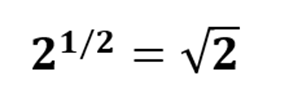
An exponent of 1/3 is a cube root, for example,

An exponent of 1/4 is a forth root, for example,


Rules of Exponents
Zero-Exponent Rule: a0=1. Anything having power zero is .
Explanation:
90=1
(500x4 y3 z2 )0=1
Power Rule-1: an, repeat the base value n times and then multiply them.
Explanation:
23=2×2×2=8
23=2×2×2×2=16
33=3×3×3=27
Power Rule-2: (am)n=amn, means to raise a power to power, you need to multiply powers.
Explanation:
(x5)4=x(5×4)=x20
(2x4 y2)3=2(1×3) x(4×3) y(2×3)
=23 x12 y6
=2×2×2x12 y6=8x12 y6
Power Rule-3: a(nm), here we need to apply Power Rule-1, on powers and then solve accordingly.
Explanation:
2(32)
=2(3×3)
=29
=2×2×2×2×2×2×2×2×2=512
Negative Exponent Rule: a(-n)=1/an , it means that negative exponents in the numerator get moved to the denominator and become positive exponents.
Explanation:
x(-7)=1/x7
Product Rule: am.an=a(m+n), means that you keep the base and add the powers.
Explanation:
x3.x4=x(3+4)=x7
y.y3=y(1+3)=y4
Quotient Rule: am/an =a(m-n), mean keep the base and subtract the power present in division.
Explanation:
x^7/x^3 =x^(7-3)=x^4
(x7 y9)/(x3 y4)=x(7-3) y(9-4)=x4 y5
Square Roots and Cube Roots
Roots also called radicals are the opposite operation of powers. Hence, you can undo a power with a radical, and a radical can undo a power. For example, if you square 2, you will get 4 as shown below.
√4=√(2×2)=2
The symbol “√” is called the radical symbol. And, the expression “√4” is read as “root four”, “radical four”, or “square root of four”.
You can raise numbers to powers other than just 2, means you can cube things, raise them to the fourth power, raise them to the 100th power, and, so on and so forth. Similarly, you can take cube root of a number, the fourth root, the 100th root, and so on.
To indicate some root other than a square root, you use the same radical symbol, but you have to insert a number as shown below.
- Square root is written as √
- Cube root is written as ∛
- Fourth root is written as ∜
- Similarly, 100th root will be written as √(100).
Note: √ is same as 2√. But in math practice, the is not written with square root.
For example, cube of 4 is 64 as shown below.
43=4×4×4=64
And, cube root of 64 is 4 as shown below.
3√64=3√43=3√4×4×4=4
Simplifying Square Root Terms
If you have a perfect square, then square and square roots will be cancelled as shown below.
√1=√12=1
√4=√22=2
√9=√32=3
√16=√42=4
√25=√52=5
√36=√62=6
√49=√72=7
√64=√82=8
√81=√92=9
√100=√102=10
Please note here, that the value of simplified radical is always positive. This positive result is called the “principal” root.
Principal Root
Another way to simplify square root: Simplify √144
√144=√9×16=√32×42=3×4=12
Or, you can say that
√144=√122=12
Hence, the square-root of 144 is 12.
Simplify: √75
√25×3=√5×5×3=√52×3)=5√3
The answer is read as “five root three”.
Simplify: √24 √6
√24 √6=√24×6=√144=√12×12=√122=12
Perfect Square
A number is known as a perfect square if it can be expressed as the product of itself twice.
12=1×1=122=2×2=4
32=3×3=9
42=4×4=16
52=5×5=25
62=6×6=36
72=7×7=49
82=8×8=64
92=9×9=81
102=10×10=100
Similarly, you can find perfect cubes of whole numbers.
Perfect Cube
13=1×1×1=123=2×2×2=8
33=3×3×3=27
43=4×4×4=64
53=5×5×5=125
63=6×6×6=216
73=7×7×7=343
83=8×8×8=512
93=9×9×9=729
103=10×10=1000
Properties of Square roots
When square roots appear in algebra these properties guide us on how to deal with roots.
• √x×√y=√xy• √(x/y)=√x/√y
• √(x+y)≠√x+√y
• a√x+b√x=(a+b) √x
• a√x-b√x=(a-b) √x
• a√x=√(a2×x)


That”s fantastic. basic concept explained very well.
Thanks